Featured Post

Books To The Ceiling

Books to the ceiling, books to the sky. My piles of books are a mile high. How I love them! How I need them! I'll have a long beard...

Thursday, March 31, 2016

Emotions aren't single words.


Emotions, in my experience, aren't covered by single words. I don't believe in "sadness," "joy," or "regret." Maybe the proof that the language is patriarchal is that it oversimplifies feeling. 

I'd like to have at my disposal complicated hybrid emotions, Germanic train-car constructions like, say, "the happiness that attends disaster." Or: "the disappointment of sleeping with one's fantasy." I'd like to show how "intimations of mortality brought on by aging family members" connects with "the hatred of mirrors that begins in the middle age." I'd like to have a word for "the sadness inspired by failing restaurants" as well as for "the excitement of getting a room with a minibar." I've never had the right words to describe my Life, and now that I've entered my story, I need them more than ever. 

I can't just sit back and watch from a distance anymore. From here on in, everything I'll tell you is colored by the subjective experience of being part of events. Here's where my story splits, divides, undergoes meiosis. Already the world feels heavier, now I'm a part of it. I'm talking about bandages and stopped cotton, the smell of mildew in the movie theaters, and of all the lousy cats and their stinking litter boxes, of rain on city streets when the dust comes up and the old Italian men take their folding chairs inside. Up until now it hasn't been my world. Not my America. But here we are, at last.


Wednesday, February 10, 2016

The Wise Old Owl


A wise old owl sat on an oak; The more he saw the less he spoke; The less he spoke the more he heard: Why aren't we like that wise old bird?
~ Charles M. Schulz

Tuesday, October 20, 2015

Middlesex | The Oracular Vulva

Peter Luce had appeared on Phil Donahue along with two hermaphrodites and a transsexual to discuss both the medical and psychological aspects of these conditions. On that program, Phil Donahue said, "Lynn Harris was born and raised a girl. You won the Miss Newport Beach Contest in 1964 in good old Orange County, California? Boy, wait till they hear this. You lived as a woman to the age of twenty-nine and then you switched to living as a man. He has the anatomical characteristics of both a man and a woman. If I'm lyin', I'm dyin'."

He also said, "Here's what's not so funny. These live, irreplaceable sons and daughters of God, human beings all, want you to know, among other things, that that's exactly what they are, human beings."

Because of certain genetic and hormonal conditions, it was sometimes very difficult to determine the sex of a newborn baby. Confronted with such a child, the Spartans had left the infant on a rocky hillside to die. Luce's own forebears, the English, didn't even like to mention the subject, and might never have done so had the nuisance of mysterious genitalia not thrown a wrench into the smooth workings of inheritance Law. Lord Coke, the great British Jurist of the seventeenth century, tried to clear up the matter of who would get the landing estates by declaring that a person should "be either male of female, and it shall succeed according to the kind of sex which doth prevail." Of course, he didn't specify any precise method for determining which sex did prevail. For most of the twentieth century, medicine had been using the same primitive diagnostic criterion of sex formulated by Klebs way back in 1876. Klebs had maintained that a person's gonads determined sex. In case of ambiguous gender, you looked at the gonadal tissue under the microscope. If it was testicular, the person was male; if ovarian, female. The hunch here was that a person's gonads would orchestrate sexual development, especially at puberty. But it turned out to be more complicated than that. Klebs had begun the task, but the world had to wait another hundred years for Peter Luce to come along and finish it. 

In 1955, Luce published an article called "Many Roads Lead to Rome: Sexual Concepts of Human Hermaphroditism." In twenty-five pages of forthright, high-toned prose, Luce argued that gender is determined by a variety of influences: chromosomal sex; gonadal sex; hormones; internal genital structures; external genitals; and, most important, the sex of rearing. Drawing on studies of patients at the pediatric endocrine clinic at New York Hospital, Luce was able to compile charts demonstrating how these various factors came into play, and showing that a patient's gonadal sex often didn't determine his or her gender identity. The article made a big splash. Within months, pretty much everyone had given up Klebs's criterion for Luce's criteria.

On the strength of this success, Luce was given the opportunity to open the Psychohormonal Unit at New York Hospital. In those days he saw mostly kids with adrenogenital syndrome, the most common form of female hermaphroditism. The hormone cortisol, recently synthesized in the lab, had been found to arrest the virilization these girls normally underwent, allowing them to develop as Luce oversaw the girls' psychosexual development. He learned a lot. In a decade of solid, original research, Luce made his second great discovery: that gender identity is established very early on in life, about the age of two. Gender was like a native tongue; it didn't exist before birth but was imprinted in the brain during childhood, never disappearing. Children learn to speak Male or Female the way they learn to speak English or French.

Monday, August 17, 2015

It's Quiet Now


It's quiet now, and as I think my thoughts alone,
I try to keep my head straight, but I think I'm too far gone.
for in this silence, the truth rings even louder.
a constant grinding begging recognition of its power.
through its eyes I take the trip, destiny: the place
of pain and pleasure absolute, where sorrow has a face
a place if time where spirit, asked to stand and hold its ground
has lost all equilibrium and is slowly sinking down.
down into the darkness that the lack of will affords,
down into the shadows, past the junkies past the whores
down into the mire, suffocating all that lives,
but if I say "I care" i lie for I've no more left to give.
well, I suppose a hand would help. oh yeah, there's no one here.
guess that's what I wanted (once again my greatest fear).
I just long to hear a bird song, just to let me know there's light.
for as we all know a songbird never sings its song at night.
but, its quiet now.

a thought, a subtle image, comes creeping around again
a vision clear as day then projects onto my lens.
with my little heart I often hope for once, all hopes not lost...
but even as I try I find, the truth demands a cost.
exacted from my soul (my only means of recompense)
taken as a toll for even knowledge charges rent
removed from me without consent iI've now a hole to fill
compounded by the fact that I hear the grinding still
the darkness sure and silent holds fast beyond my reach
a ray of light has not a chance, the shadows can't be breached
a fight ensues and all is waged until the end has come
a battle to the death pits a father against his son
what now? I ask the guide of this me my final fate
and I'm led into the cell, I hear the closing of the gate.
the silence I once feared is at last my final end
and the silence I once hated has become my only friend, again.
it's quiet now.

Derrick Carter

Work In Digress. Me, But I Digress...

Waking Life: I Don't Want To Be An Ant

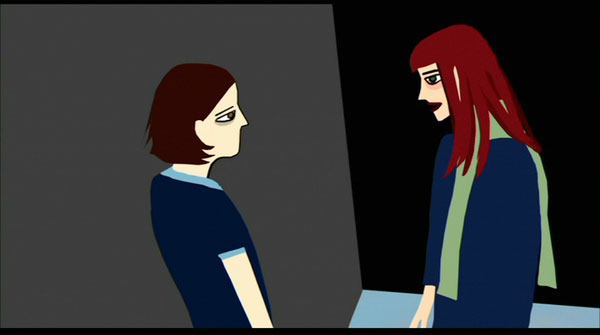
(Main character is coming out of a subway and bumps into a girl.)

Excuse me.

Excuse me.

Waking Life: Chapter 14 - Ants
Hey. Could we do that again? I know we haven't met, but I don't want to be an ant, you know? I mean, it's like we go through life with our antennas bouncing off one another, continuously on ant autopilot with nothing really human required of us. Stop. Go. Walk here. Drive there. All action basically for survival. All communication simply to keep this ant colony buzzing along in an efficient polite manner. "Here's your change." "Paper or plastic?" "Credit or debit?" "You want ketchup with that?" I don't want a straw, I want real human moments. I want to see you. I want you to see me. I don't want to give that up. I don't want to be an ant, you know?

Yeah. Yeah, no. I don't want to be an ant either. Heh. Yeah, thanks for kind of jostling me there. I've been kind of on zombie autopilot lately, I don't feel like an ant in my head, but I guess I probably look like one. It's kind of like D.H. Lawrence had this idea of two people meeting on a road. And instead of just passing and glancing away, they decide to accept what he calls "the confrontation between their souls." It's like, um, freeing the brave reckless gods within us all.

Then it's like we have met.

(They shake hands)


Thursday, May 14, 2015

The Cuddle Hormone

Oxytocin

Oxytocin (/ˌɒksɨˈtsɪn/Oxt) is a mammalian neurohypophysial hormone. Produced in the supraoptic and paraventricular nuclei of the hypothalamus by nerve axons, and stored in theposterior pituitary gland, oxytocin acts primarily as a neuromodulator in the brain.
Oxytocin plays an important role in the neuroanatomy of intimacy, specifically in sexual reproduction of both sexes, in particular during and after childbirth. It is released in large amounts after distension of the cervix and uterus during labor, facilitating birthmaternal bonding, and, after stimulation of the nippleslactation. Both childbirth and milk ejection result from positive feedback mechanisms.[3]
Recent studies have begun to investigate oxytocin's role in various behaviors, including orgasmsocial recognitionpair bondinganxiety, and maternal behaviors.[4] For this reason, it is sometimes referred to as the "bonding hormone". There is some evidence that oxytocin promotes ethnocentric behavior, incorporating the trust and empathy of in-groups with their suspicion and rejection of outsiders.[5] Furthermore, genetic differences in the oxytocin receptor gene (OXTR) have been associated with maladaptive social traits such as aggressive behaviour.[6]
NBC TODAY Show
We Need to Know Exactly How Our Dog Really Feels About Us


Autism study says 'cuddle hormone' oxytocin, may help relax children with social anxiety

Saturday, April 18, 2015

Memes and the Behavior of Beliefs

There's another kind of filtering that limits how much of the mind field we can perceive. This has to do with creating beliefs and then accepting them as real. A belief is an idea we hold on to. For example, if you believe that God is good, that women are mysterious, or that life is unfair, you have taken generations of shared experience and reduced it to one conclusion. The conclusion may be right or wrong; that's not important for the moment. Beliefs hold us together as a society. Such shared beliefs give us a clue about how mind might exist outside the body.

We all carry in our minds a large database of information that we consider fundamental. This database holds everything important that we believe about the world. It is our worldview. We depend upon it to survive for even a short time. Beliefs evolve over the centuries, and therefore some researchers look upon beliefs as being like "virtual genes," that become fixed characteristics of the brain. Theses mental genes were named "memes" by the British evolutionist Richard Dawkins, who founded a new field overnight that has proliferated considerably since then.

A meme is often compared to a virus that spreads from person to person until an entire society gets infected. It wouldn't be beneficial to our species to become infected by everything. If we were actually open to all new ideas, we would not be able to maintain a coherent view of the world. Imagine changing your view of the opposite sex, for example, every time you met a new person. In order to evolve, human beings had to make sure that they accepted only "good" memes--ideas that promoted a coherent, reliable worldview--and rejected "bad" memes, ideas that moved the mind in the opposite direction.

The basic fact that we can track the spread of beliefs the way we track the spread of avian flu provides us with another clue to the nature of the mind field: it is dynamic, shared, evolving, and powerful. It is capable of "infecting" us with good or bad beliefs without the individual actually going through any experience at all. Thus societies fight and die defending a God few have personally experienced. Nietzsche was foreshadowing memes when he said that a mistaken idea " grows from generation unto generation, merely because people believe in it, until it gradually grows to be a part of the thing and turns into its very body. What at first was appearance becomes in the end, almost invariably, the essence, and is effective as such."

~ Life After Death: The Burden of Proof
by Deepak Chopra

Friday, February 20, 2015

Books of The Earth Chronicles Series


Dear Reader,
The Earth Chronicles series is based on the premise that mythology is the depository of ancient recollections, that the Bible should be read literally as a historic-scientific document, and that ancient civilizations were the product of knowledge brought to Earth by the Anunnaki—"Those who from Heaven to Earth came."
Complementing each other and serving to bring the saga of gods and humans on Earth ever closer to our time, each book of the series looks at this awesome tale from a different perspective.

The 12th Planet, the first book of the series, brings to life the Sumerian civilization and presents millennia-old evidence of the existence of Nibiru, the home planet of the Anunnaki, and the landings of the Anunnaki on Earth every 3,600 years.

The Stairway to Heaven, the second book, incorporates ancient Egyptian evidence to show that the gateway between the mortal and the divine was a spaceport in the Sinai Peninsula, with the Giza pyramids and the Sphinx serving as beacons for the landings.

The Wars of Gods and Men, the third book, additionally embraces Canaanite, Hittite, and Hindu sources to include in these investigations the incidents of the Tower of Babel and the upheaval of Sodom and Gomorrah, concluding that nuclear weapons were used on Earth 4,000 years ago.

The Lost Realms, the fourth book, transports readers to the pre-Columbian civilizations and ancient empires of the Americas, revealing hitherto unrecognized golden links between ancient Near Eastern civilizations and the "cities of the gods" of the Olmecs, Mayas, Aztecs, and Incas.

When Time Began, the fifth book, explores ancient knowledge of Heaven and Earth and the interwoven cycles that gave rise to astronomy, the zodiac and astrology, and stone calendars such as Stonehenge, revealing the secret of New Ages past and future.

And The Cosmic Code, the sixth book in the series, explains how the secrets of humankind's celestial teachers were encoded in the Bible and other sacred and hidden "books "—a cosmic code that links Earthlings to their cosmic roots.

In the years since each book was published, new scientific discoveries have provided mounting corroboration of the series' incredible and unorthodox science-based conclusions. This accumulation of discoveries and the origins of humankind and the solar system are further discussed in the companion books Genesis Revisited and Divine Encounters.
I trust that modern science will continue to confirm ancient knowledge.”

Excerpt From: Sitchin, Zecharia. “The 12th Planet.” Bear & Company, 2011-05-24.
iBooks Store 

Books of The Earth Chronicles Series

Friday, February 13, 2015

The Guf is empty, there is no bird song and human beings are born without a soul


The stars above the night
Shine out on the sins of us all.

The prince and the fool battle out
2000 years apocalypse shall fall.

Just as the scriptures told
The first of seven signs
Our fate rests on the shoulders of hope.

Look into the Guff the sparrow sings his song
When the hall is emptied the sparrow sings no more
It's the seventh sign, it's the final warning
Life's colors turn to stone, she is left to save the world alone.

With the help of the knowledge
She solves the questions to break the chain.

The mortal cries out who dies for the
Word of God must be saved.

Child of the future
The world of God is spoken
The wrath of his fury it can be broken.

Look into the Guff the sparrow sings his song
When the hall is emptied the sparrow sings no more
It's the seventh sign, it's the final warning
Life's colors turn to stone, she is left to save the world alone.

The sparrow is still singing...

She reaches out to save him
But the final sign has already come.

And in the hour of loneliness
She gives birth to the soul - less one.

The dream begins to open
The questions asked again
The answer has been chosen
I will die for him.

Look into the Guff the sparrow sings his song
When the hall is emptied the sparrow sings no more
It's the seventh sign, it's the final warning
Life's colors turn to stone, she is left all alone.

Look into the Guff the sparrow sings his song
When the hall is emptied the sparrow sings no more
It's the seventh sign, it's the final warning
Life's colors turn to stone, she is left to save the world alone.

The heavens are calm again

Remember...

The Guf IS empty, there is no bird song and human beings are born without a soul after the loss of the last Innocent soul


The Tree of Souls

According to Jewish mythology, in the Garden of Eden there is a Tree of life or the Tree of Souls that blossoms and produces new souls, which fall into the Guf, the Treasury of Souls. Gabriel reaches into the treasury and takes out the first soul that comes into his hand. Then Lailah, the Angel of Conception, watches over the embryo until it is born.

According to Rabbi Isaac Luria, the trees are resting places for souls and sparrows can see the soul's descent, explaining their joyous chirping. The Tree of Souls produces all the souls that have ever existed, or will ever exist. When the last soul descends, the world will come to an end. According to the Talmud, Yevamot 62a, is that the Messiah will not come until the Guf is emptied of all its souls. In keeping with other Jewish legends that envision souls as bird-like, the Guf is sometimes described as a columbarium, or birdhouse. The mystic significance of the Guf is that each person is important and has a unique role which only he or she, with his or her unique soul, can fulfill. Even a newborn baby brings the Messiah closer simply by being born.

The peculiar idiom of describing the treasury of souls as a "body" may be connected to the mythic tradition of Adam Kadmon, the primordial man. Adam Kadmon, God's "original intention" for humanity, was a supernal being, androgynous and macro-cosmic (co-equal in size with the universe). When this Adam sinned, humanity was demoted to the flesh and blood, bifurcated and mortal creatures we are now. According to Kabbalah, every human soul is just a fragment (or fragments) cycling out of the great "world-soul" of Adam Kadmon. Hence, every human soul comes from the guf [of Adam Kadmon].
Guf

The Seventh Sign (1988)

Friday, February 6, 2015

The Man Who Belonged On Earth

     He looked at her and chuckled; it was a sound of pain. "Have you been tortured by it too, Miss Taggart? By the impossibility of finding any sort of intelligence anywhere?"

     He Leaned back; he looked as if some hidden smile were smoothing the tension away from his face. "I wish I could help you," he said, as to a comrade. "I most selfishly wish I could help you, because, you see, this has been my hardest problem―trying to find men of talent for my own staff. Talent, hell! I'd be satisfied with just a semblance of promise―but the men they send me couldn't be honestly said to possess the potentiality of developing into decent garage mechanics. I don't know whether I am getting older and more demanding, or whether the human race is degenerating, but the world didn't seem to be so barren of intelligence in my youth. Today, if you saw the kind of men I've had to interview, you'd―"

 "It's so wonderful," said Dr. Stadler, his voice low. "It's so wonderful to see a great, new, crucial idea which is not mine!"
     She looked at him, wishing she could believe that she understood him correctly. He spoke, in passionate sincerity, discarding convention, discarding concern for whether it was proper to let her hear the confession of his pain, seeing nothing but the face of a woman who was able to understand:
     "Miss Taggart, do you know the hallmark of the second-rater? It's resentment of another man's achievement. Those touchy mediocrities who sit trembling lest someone's work prove greater than their own―they have no inkling of the loneliness that comes when you reach the top. the loneliness for an equal―for a mind to respect and an achievement to admire. They bare their teeth at you from out of their rat holes. thinking that you take pleasure in letting your brilliance dim them―while you'd give a year of your life to see a flicker of talent anywhere among them. They envy achievement, and their dream of greatness is a world where all men have become their acknowledged inferiors. They don't know that that dream is the infallible proof of mediocrity, because that sort of world is what the man of achievement would not be able to bear. They have no way of knowing what he feels when surrounded by inferiors―hatred? no, not hatred, but boredom―the terrible, hopeless, draining, paralyzing boredom. Of what account are praise and adulation from men whom you don't respect? Have you ever felt the longing for someone you could admire? For something, not to look down at, but up to?"
"I've felt it all my life," she said. It was an answer she could not refuse him.

Atlas Shrugged

"We read to know we're not alone."

"We read to know we're not alone." —William Nicholson

Novelist and playwright William Nicholson won a Tony for his first Broadway production, Shadowlands, about the deep friendship and eventual love between C.S. Lewis and Joy Gresham, who wrote under the name Joy Davidman—this quote comes from Nicholson's script. After Gresham's death, Lewis wrote a powerful meditation on his sorrow, titled A Grief Observed, which includes this touching description:
"She was my daughter and my mother, my pupil and my teacher, my subject and my sovereign; and always, holding all these in solution, my trusty comrade, friend, shipmate, fellow-soldier. My mistress; but at the same time all that any man friend (and I have good ones) has ever been to me. Perhaps more."
 5 Inspiring Quotes to Wrap Up the Year

Wednesday, January 28, 2015

Syrup

~ thank you very much
Cindy leaves at eight, and about ten I drag myself into the bathroom and stare at myself in the mirror for a while. Then I shower, pull on jeans and a T-shirt, and eat breakfast in front of whatever comes up when I turn the TV on, which happens to be an Elvis movie.
 A little while later I realize that I'm staring at the screen without really seeing it, so I try to pull myself together by calling a few advertising agencies to see if anyone has a spot for Cindy. One guy asks if Cindy will sleep with him for a spot, and I tell him no but I will.
 I do three more calls, then realize that I'm staring pointlessly at my shoes. The phone is dangling from my hand, emitting quiet tones to itself. Five months ago, this stuff was actually fun.
 I Look at the screen, where Elvis is sitting on a log and strumming thoughtfully at his guitar. A sprightly girl in a bright orange sweater is sitting at his feet with an enraptured expression, like Elvis knows the answer to everything. "Elvis," I say emotionally.
"Tell me what's wrong with me."
 Elvis says to the girl, "Well, I guess I just love my music. I love making it all up. Some people go through their whole lives without ever getting to create something, you know? If that was me, heck, I'd go crazy."
 I stare at the TV, open-mouthed.
 "Elvis," I say eventually, " they didn't call you the King for nothing."


~ mktg art
I'm expecting that 6 will want to stay at this party for roughly five minutes, but three hours later, she's sipping neat vodka and guarding a prime position on the sofa. The closest I can get to her is a tight group with Tina, so I strike up a conversation.
"So," I say, "you're okay with the fact that your artwork was actually liked by a corporation?"
Tina sips at her beer. "I didn't produce art."
"I mean the film. Art, right?"
"No," Tina says. "Not."
I'm lost. "What?"
"Art and marketing can't coexist," Tina says. "It's either one or the other."
"Not this again," 6 says from the sofa.
Tina ignores her. "I made the film for you with the intention of appealing to a bunch of corporate suits. That I used artistic techniques to do it is irrelevant."
"Just because it's aimed at a particular market means it's not art?" I say.
Tina nods once. "Exactly."
I frown. "What if I take a work of art and market it? It's still art, right?"
"You can't take artwork and just tweak it to be more commercially appealing." She sips at her beer. "Not without destroying its artistic merit."
"Tina, this is so crap," 6 says, standing up. "If I showed you a painting but didn't tell you whether it was created by a starving artist or an agency commissioned to produce it, you couldn't tell me whether it was art or not."
"Oh, I think I'd be able to tell," Tina says.
6 shifts impatiently. "Who cares what the intent was? It's the result that matters."
"The intent is not dividable from the results," Tina says. "I know you people don't want to face that, but it's true."
"You don't want to face the fact that marketing is the greatest producer of art on the planet. There's packaging, copy, TV advertising--can you tell me why that's not art?"
"If you can't make the distinction yourself, I won't be able to explain it to you."
"Oh, right," 6 says, "you think some hack's poems that no one ever reads are more important than a movie half the world sees? A lot more people have seen a Coke can than a van Gogh."
"I've noticed you corporate people do this," Tina says. "Confuse popularity with quality."
"It's a democratic society, Tina," 6 says. "Your opinion of quality is no more valid than mine. Popularity is quality.
And so marketers are today's real artists."
"Drink, anyone?" I say.

Syrup

Friday, January 16, 2015

Ninurta: Heavenly Bull, Earthly Lion. Lord of the Land, Powerful among the Anunnaki.

E.Y.E: Divine Cybermancy - Rimanah
Fig. 93
Fan Artwork
Listing all his attributes and heirlooms, Ninurta thus asserted:
In Heaven I am a wild bull,
On Earth I am a lion.
In the land I am the lord,
among the gods I am the fiercest.
The hero of the Igigi I am,
among the Anunnaki I am powerful.

The statement asserts verbally what the depictions, such as we have shown in Fig. 93, have illustrated pictorially: the zodiacal time when the spring equinox began in the House of the Bull (Taurus) and the summer solstice occurred in the zodiac of the Lion (Leo) belonged to the Enlilites, whose "cult animals" were the Bull and the Lion.”

Excerpt From: Sitchin, Zecharia. “When Time Began (Book V).” Bear & Company, 2011-05-22. iBooks Store 

When Time Began (Earth Chronicles #5)

Monday, October 6, 2014

No one can afford to live in New York!


“Whenever people say ‘I can’t really afford to live in New York,’ I say ‘No one can afford to live in New York! You just stay here and as long as you’re not in jail, you’re living in New York. You have no idea how you paid all this rent. If you add up all your rent from 1968, you realize you can be like, a prince from Dubai. How did you pay this? You don’t know. The entire time I lived here, I lived inside. It’s an amazing feat! I don’t know how I did it. I don’t. I don’t know how you do it. Neither do you.”

Fran Lebowitz On New York’s Lack of Affordability

Missed Connections on the New York Subway

"This City is what it is because our citizens are what they are." ~ Plato

Sunday, October 5, 2014

Psychonauts


In his introduction, Thurman also notes Evans-Wentz's misnomer but calls his translation The Tibetan Book of the Dead. And like the Evans-Wentz version, about half of Thurman's work is taken up with his own commentary and glossary. Part of the commentary is taken up by Thurman's interpretation of the Bar do thos grol, a Nyingma text, in light of the antic theory of the great Geluk master, Tsong kha pa (1357-1419). But much of Thurman's introduction is reminiscent of Evans-Wentz. For Thurman, Tibet was a unique civilization. while the West has devoted itself to the investigation and conquest of the material world and outer space, Tibet was an inwardly directed society the produced generations of mystical adepts who studied spiritual technologies and became "Inner world adventurers of the highest daring" he calls them psychonauts" who "personally voyage to the furthest frontiers of the universe which their society deemed vital to explore: the inner frontiers of consciousness itself, in all its transformations of life and beyond death." As a product of this society, The Tibetan Book of the Dead is not a Buddhist approach to death and dying but a scientific description of the death process, derived from the research of Psychonauts. The Tibetan views of death are no more or less religious than modern Western views on the structure of the solar system. In the preface of the third edition, Evans-Wentz had written that the book "reveals to the people of the Occident a science of death and rebirth such as only the peoples of the Orient have heretofore known"

In the 1990 film Jacob's Ladder, a Vietnam Veteran experiences disturbing hallucinations, and the viewer, like the protagonist, is unable to distinguish reality from illusion. In the end, it is revealed that the entire film has been the visions of an American soldier in Vietnam as he dies on the operating table. He is finally led to a light be a child. The director Adrian Lyne explained in interviews that the film had been inspired by The Tibetan Book of the Dead.

(p251-252) The Tibetan Book of The Dead ~ Afterword: Psychonauts
 — with Donald S. Lopez Jr

Depression, the secret we share

The Colossus (painting)
"The opposite of depression is not happiness, but vitality, and it was vitality that seemed to seep away from me in that moment." In a talk equal parts eloquent and devastating, writer Andrew Solomon takes you to the darkest corners of his mind during the years he battled depression. That led him to an eye-opening journey across the world to interview others with depression — only to discover that, to his surprise, the more he talked, the more people wanted to tell their own stories. (Filmed at TEDxMet.)

Andrew Solomon: Depression, the secret we share

Every Seven Years You Change


ARE you the same person now that you were fifteen years ago? In fact, are you the same person you were just seven years ago? Most of us have heard the old saying that every cell in the body is changed over a period of seven years; but recent investigation has uncovered facts of far more significance to us as human beings. This concerns the emotional, physical and mental changes that seem to occur in approximate seven-year intervals. Of course there are no fixed boundaries and so one may achieve these levels of maturity at any period of our life. so what follows are simply the general changes you may find.

Rudolph Steiner, the great teacher of Anthroposophy said that the seven-year cycles continue throughout life, and are of the utmost importance to doctors, teachers, psychiatrists and the social sciences. Without some smattering of these changes it is difficult for anyone to understand the relationship of any given individual with his or her environment. So I have tried to summarise what Steiner and others have said about the cycles.

Before the definition is started, I feel it is important to say that as humans, in fact as any life form, we are creatures of great polarities. Or as the philosopher Erwin Goodenough said, “A book on love, loyalty or justice would gain little but pedantry by starting out with a concise definition of the term. Only as we describe the various conflicting elements associated with such words can we finally arrive at a meaning that includes these complexities; for important matters we understand, not as we simplify, but as we tolerate the paradoxical.”

One of the great paradoxes of our lives are that we constantly go through such enormous such massive changes every day. Daily we pass through an extraordinary change that we often take so much for granted we miss the wonder of it. The change occurs between sleeping and waking. For most of us being awake is when we most fully feel ourselves. Compared with this sleeping is a period during which we lose any focused awareness of being an individual, and we sink into what is generally called unconsciousness — the lack of personal awareness.

This swing between waking and sleeping can be seen as the extremes within the possibilities of our experience. Sleeping and waking are the polarities, the North and South Poles of what we can confront. In quite a real sense we can say there is nothing beyond what is included in those polarities. But there is an enormous difference between waking experience and the experience of dreamless sleep. Yes, one can have an experience of what is considered deep unconsciousness. In waking we have a sensation of time, of being in a locality, of separateness and even isolation. But at the other end of that polarity we have a sense of timelessness and non-locality. What was a sense of self merges into an ocean of awareness. See Levels of Awareness in Sleeping and Waking.

http://dreamhawk.com/body-and-mind/every-seven-years-you-change/


"If we don't change, we don't grow. If we don't grow, we aren't really living."
~ Gail Sheehy

Every numeral of the series of numbers is associated with some interesting facts. The repeating nature of a certain number in different spheres of life can be a coincidence or simply a wonder! What do you think? Read on to know some interesting facts about the number seven.

Sunday, August 10, 2014

Limitations of Cleverness

"Cleverness, after all, has its limitations. Its mechanical judgments and clever remarks tend to prove inaccurate with passing time, because it doesn't look very deeply into things to begin with. It has to change its opinions later on because of what it didn't see when it was forming them. The thing that makes someone truly different -- unique, in fact -- is something that Cleverness cannot really understand."
~ The Tao of Pooh

Saturday, March 15, 2014

Book Smarts vs. Street Smarts


"Knowledge and Experience do not necessarily speak the same language. Knowledge that comes from experience is more valuable than the knowledge that doesn't. There is more to knowing than just being correct."
~ the Tao of Pooh