A wise old owl sat on an oak; The more he saw the less he spoke; The less he spoke the more he heard: Why aren't we like that wise old bird?
~ Charles M. Schulz
Peter Luce had appeared on Phil Donahue along with two hermaphrodites and a transsexual to discuss both the medical and psychological aspects of these conditions. On that program, Phil Donahue said, "Lynn Harris was born and raised a girl. You won the Miss Newport Beach Contest in 1964 in good old Orange County, California? Boy, wait till they hear this. You lived as a woman to the age of twenty-nine and then you switched to living as a man. He has the anatomical characteristics of both a man and a woman. If I'm lyin', I'm dyin'."
He also said, "Here's what's not so funny. These live, irreplaceable sons and daughters of God, human beings all, want you to know, among other things, that that's exactly what they are, human beings."
Because of certain genetic and hormonal conditions, it was sometimes very difficult to determine the sex of a newborn baby. Confronted with such a child, the Spartans had left the infant on a rocky hillside to die. Luce's own forebears, the English, didn't even like to mention the subject, and might never have done so had the nuisance of mysterious genitalia not thrown a wrench into the smooth workings of inheritance Law. Lord Coke, the great British Jurist of the seventeenth century, tried to clear up the matter of who would get the landing estates by declaring that a person should "be either male of female, and it shall succeed according to the kind of sex which doth prevail." Of course, he didn't specify any precise method for determining which sex did prevail. For most of the twentieth century, medicine had been using the same primitive diagnostic criterion of sex formulated by Klebs way back in 1876. Klebs had maintained that a person's gonads determined sex. In case of ambiguous gender, you looked at the gonadal tissue under the microscope. If it was testicular, the person was male; if ovarian, female. The hunch here was that a person's gonads would orchestrate sexual development, especially at puberty. But it turned out to be more complicated than that. Klebs had begun the task, but the world had to wait another hundred years for Peter Luce to come along and finish it.
In 1955, Luce published an article called "Many Roads Lead to Rome: Sexual Concepts of Human Hermaphroditism." In twenty-five pages of forthright, high-toned prose, Luce argued that gender is determined by a variety of influences: chromosomal sex; gonadal sex; hormones; internal genital structures; external genitals; and, most important, the sex of rearing. Drawing on studies of patients at the pediatric endocrine clinic at New York Hospital, Luce was able to compile charts demonstrating how these various factors came into play, and showing that a patient's gonadal sex often didn't determine his or her gender identity. The article made a big splash. Within months, pretty much everyone had given up Klebs's criterion for Luce's criteria.
On the strength of this success, Luce was given the opportunity to open the Psychohormonal Unit at New York Hospital. In those days he saw mostly kids with adrenogenital syndrome, the most common form of female hermaphroditism. The hormone cortisol, recently synthesized in the lab, had been found to arrest the virilization these girls normally underwent, allowing them to develop as Luce oversaw the girls' psychosexual development. He learned a lot. In a decade of solid, original research, Luce made his second great discovery: that gender identity is established very early on in life, about the age of two. Gender was like a native tongue; it didn't exist before birth but was imprinted in the brain during childhood, never disappearing. Children learn to speak Male or Female the way they learn to speak English or French.
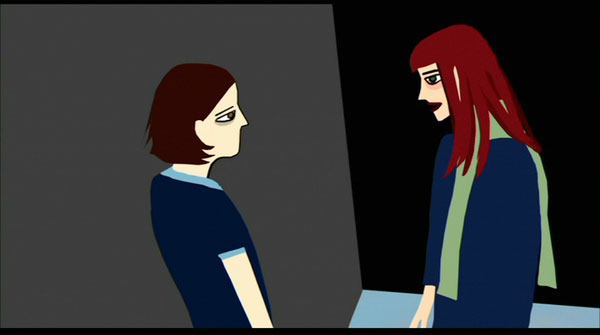
(Main character is coming out of a subway and bumps into a girl.)
Excuse me.
Excuse me.
Hey. Could we do that again? I know we haven't met, but I don't want to be an ant, you know? I mean, it's like we go through life with our antennas bouncing off one another, continuously on ant autopilot with nothing really human required of us. Stop. Go. Walk here. Drive there. All action basically for survival. All communication simply to keep this ant colony buzzing along in an efficient polite manner. "Here's your change." "Paper or plastic?" "Credit or debit?" "You want ketchup with that?" I don't want a straw, I want real human moments. I want to see you. I want you to see me. I don't want to give that up. I don't want to be an ant, you know?
Yeah. Yeah, no. I don't want to be an ant either. Heh. Yeah, thanks for kind of jostling me there. I've been kind of on zombie autopilot lately, I don't feel like an ant in my head, but I guess I probably look like one. It's kind of like D.H. Lawrence had this idea of two people meeting on a road. And instead of just passing and glancing away, they decide to accept what he calls "the confrontation between their souls." It's like, um, freeing the brave reckless gods within us all.
Recent studies have begun to investigate oxytocin's role in various behaviors, including orgasm, social recognition, pair bonding, anxiety, and maternal behaviors.[4] For this reason, it is sometimes referred to as the "bonding hormone". There is some evidence that oxytocin promotes ethnocentric behavior, incorporating the trust and empathy of in-groups with their suspicion and rejection of outsiders.[5] Furthermore, genetic differences in the oxytocin receptor gene (OXTR) have been associated with maladaptive social traits such as aggressive behaviour.[6]
There's another kind of filtering that limits how much of the mind field we can perceive. This has to do with creating beliefs and then accepting them as real. A belief is an idea we hold on to. For example, if you believe that God is good, that women are mysterious, or that life is unfair, you have taken generations of shared experience and reduced it to one conclusion. The conclusion may be right or wrong; that's not important for the moment. Beliefs hold us together as a society. Such shared beliefs give us a clue about how mind might exist outside the body.
We all carry in our minds a large database of information that we consider fundamental. This database holds everything important that we believe about the world. It is our worldview. We depend upon it to survive for even a short time. Beliefs evolve over the centuries, and therefore some researchers look upon beliefs as being like "virtual genes," that become fixed characteristics of the brain. Theses mental genes were named "memes" by the British evolutionist Richard Dawkins, who founded a new field overnight that has proliferated considerably since then.
A meme is often compared to a virus that spreads from person to person until an entire society gets infected. It wouldn't be beneficial to our species to become infected by everything. If we were actually open to all new ideas, we would not be able to maintain a coherent view of the world. Imagine changing your view of the opposite sex, for example, every time you met a new person. In order to evolve, human beings had to make sure that they accepted only "good" memes--ideas that promoted a coherent, reliable worldview--and rejected "bad" memes, ideas that moved the mind in the opposite direction.
The basic fact that we can track the spread of beliefs the way we track the spread of avian flu provides us with another clue to the nature of the mind field: it is dynamic, shared, evolving, and powerful. It is capable of "infecting" us with good or bad beliefs without the individual actually going through any experience at all. Thus societies fight and die defending a God few have personally experienced. Nietzsche was foreshadowing memes when he said that a mistaken idea " grows from generation unto generation, merely because people believe in it, until it gradually grows to be a part of the thing and turns into its very body. What at first was appearance becomes in the end, almost invariably, the essence, and is effective as such."
Dear Reader, The Earth Chronicles series is based on the premise that mythology is the depository of ancient recollections, that the Bible should be read literally as a historic-scientific document, and that ancient civilizations were the product of knowledge brought to Earth by the Anunnaki—"Those who from Heaven to Earth came." Complementing each other and serving to bring the saga of gods and humans on Earth ever closer to our time, each book of the series looks at this awesome tale from a different perspective. The 12th Planet, the first book of the series, brings to life the Sumerian civilization and presents millennia-old evidence of the existence of Nibiru, the home planet of the Anunnaki, and the landings of the Anunnaki on Earth every 3,600 years. The Stairway to Heaven, the second book, incorporates ancient Egyptian evidence to show that the gateway between the mortal and the divine was a spaceport in the Sinai Peninsula, with the Giza pyramids and the Sphinx serving as beacons for the landings.
The Wars of Gods and Men, the third book, additionally embraces Canaanite, Hittite, and Hindu sources to include in these investigations the incidents of the Tower of Babel and the upheaval of Sodom and Gomorrah, concluding that nuclear weapons were used on Earth 4,000 years ago. The Lost Realms, the fourth book, transports readers to the pre-Columbian civilizations and ancient empires of the Americas, revealing hitherto unrecognized golden links between ancient Near Eastern civilizations and the "cities of the gods" of the Olmecs, Mayas, Aztecs, and Incas.
When Time Began, the fifth book, explores ancient knowledge of Heaven and Earth and the interwoven cycles that gave rise to astronomy, the zodiac and astrology, and stone calendars such as Stonehenge, revealing the secret of New Ages past and future. And The Cosmic Code, the sixth book in the series, explains how the secrets of humankind's celestial teachers were encoded in the Bible and other sacred and hidden "books "—a cosmic code that links Earthlings to their cosmic roots.
In the years since each book was published, new scientific discoveries have provided mounting corroboration of the series' incredible and unorthodox science-based conclusions. This accumulation of discoveries and the origins of humankind and the solar system are further discussed in the companion books Genesis Revisited and Divine Encounters. I trust that modern science will continue to confirm ancient knowledge.”
Excerpt From: Sitchin, Zecharia. “The 12th Planet.” Bear & Company, 2011-05-24. iBooks Store


 Peter Luce had appeared on Phil Donahue along with two hermaphrodites and a transsexual to discuss both the medical and psychological aspects of these conditions. On that program, Phil Donahue said, "Lynn Harris was born and raised a girl. You won the Miss Newport Beach Contest in 1964 in good old Orange County, California? Boy, wait till they hear this. You lived as a woman to the age of twenty-nine and then you switched to living as a man. He has the anatomical characteristics of both a man and a woman. If I'm lyin', I'm dyin'."