Featured Post

Books To The Ceiling

Books to the ceiling, books to the sky. My piles of books are a mile high. How I love them! How I need them! I'll have a long beard...

Monday, August 17, 2015

Waking Life: I Don't Want To Be An Ant

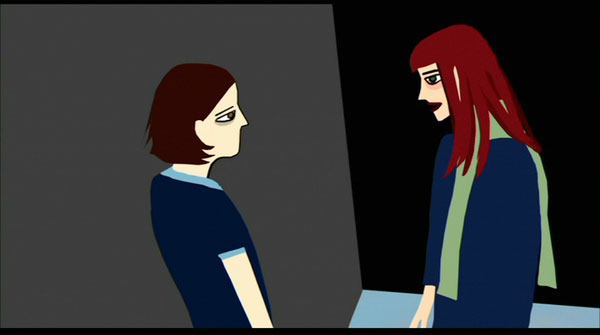
(Main character is coming out of a subway and bumps into a girl.)

Excuse me.

Excuse me.

Waking Life: Chapter 14 - Ants
Hey. Could we do that again? I know we haven't met, but I don't want to be an ant, you know? I mean, it's like we go through life with our antennas bouncing off one another, continuously on ant autopilot with nothing really human required of us. Stop. Go. Walk here. Drive there. All action basically for survival. All communication simply to keep this ant colony buzzing along in an efficient polite manner. "Here's your change." "Paper or plastic?" "Credit or debit?" "You want ketchup with that?" I don't want a straw, I want real human moments. I want to see you. I want you to see me. I don't want to give that up. I don't want to be an ant, you know?

Yeah. Yeah, no. I don't want to be an ant either. Heh. Yeah, thanks for kind of jostling me there. I've been kind of on zombie autopilot lately, I don't feel like an ant in my head, but I guess I probably look like one. It's kind of like D.H. Lawrence had this idea of two people meeting on a road. And instead of just passing and glancing away, they decide to accept what he calls "the confrontation between their souls." It's like, um, freeing the brave reckless gods within us all.

Then it's like we have met.

(They shake hands)


Thursday, May 14, 2015

The Cuddle Hormone

Oxytocin

Oxytocin (/ˌɒksɨˈtsɪn/Oxt) is a mammalian neurohypophysial hormone. Produced in the supraoptic and paraventricular nuclei of the hypothalamus by nerve axons, and stored in theposterior pituitary gland, oxytocin acts primarily as a neuromodulator in the brain.
Oxytocin plays an important role in the neuroanatomy of intimacy, specifically in sexual reproduction of both sexes, in particular during and after childbirth. It is released in large amounts after distension of the cervix and uterus during labor, facilitating birthmaternal bonding, and, after stimulation of the nippleslactation. Both childbirth and milk ejection result from positive feedback mechanisms.[3]
Recent studies have begun to investigate oxytocin's role in various behaviors, including orgasmsocial recognitionpair bondinganxiety, and maternal behaviors.[4] For this reason, it is sometimes referred to as the "bonding hormone". There is some evidence that oxytocin promotes ethnocentric behavior, incorporating the trust and empathy of in-groups with their suspicion and rejection of outsiders.[5] Furthermore, genetic differences in the oxytocin receptor gene (OXTR) have been associated with maladaptive social traits such as aggressive behaviour.[6]
NBC TODAY Show
We Need to Know Exactly How Our Dog Really Feels About Us


Autism study says 'cuddle hormone' oxytocin, may help relax children with social anxiety

Saturday, April 18, 2015

Memes and the Behavior of Beliefs

There's another kind of filtering that limits how much of the mind field we can perceive. This has to do with creating beliefs and then accepting them as real. A belief is an idea we hold on to. For example, if you believe that God is good, that women are mysterious, or that life is unfair, you have taken generations of shared experience and reduced it to one conclusion. The conclusion may be right or wrong; that's not important for the moment. Beliefs hold us together as a society. Such shared beliefs give us a clue about how mind might exist outside the body.

We all carry in our minds a large database of information that we consider fundamental. This database holds everything important that we believe about the world. It is our worldview. We depend upon it to survive for even a short time. Beliefs evolve over the centuries, and therefore some researchers look upon beliefs as being like "virtual genes," that become fixed characteristics of the brain. Theses mental genes were named "memes" by the British evolutionist Richard Dawkins, who founded a new field overnight that has proliferated considerably since then.

A meme is often compared to a virus that spreads from person to person until an entire society gets infected. It wouldn't be beneficial to our species to become infected by everything. If we were actually open to all new ideas, we would not be able to maintain a coherent view of the world. Imagine changing your view of the opposite sex, for example, every time you met a new person. In order to evolve, human beings had to make sure that they accepted only "good" memes--ideas that promoted a coherent, reliable worldview--and rejected "bad" memes, ideas that moved the mind in the opposite direction.

The basic fact that we can track the spread of beliefs the way we track the spread of avian flu provides us with another clue to the nature of the mind field: it is dynamic, shared, evolving, and powerful. It is capable of "infecting" us with good or bad beliefs without the individual actually going through any experience at all. Thus societies fight and die defending a God few have personally experienced. Nietzsche was foreshadowing memes when he said that a mistaken idea " grows from generation unto generation, merely because people believe in it, until it gradually grows to be a part of the thing and turns into its very body. What at first was appearance becomes in the end, almost invariably, the essence, and is effective as such."

~ Life After Death: The Burden of Proof
by Deepak Chopra

Friday, February 20, 2015

Books of The Earth Chronicles Series


Dear Reader,
The Earth Chronicles series is based on the premise that mythology is the depository of ancient recollections, that the Bible should be read literally as a historic-scientific document, and that ancient civilizations were the product of knowledge brought to Earth by the Anunnaki—"Those who from Heaven to Earth came."
Complementing each other and serving to bring the saga of gods and humans on Earth ever closer to our time, each book of the series looks at this awesome tale from a different perspective.

The 12th Planet, the first book of the series, brings to life the Sumerian civilization and presents millennia-old evidence of the existence of Nibiru, the home planet of the Anunnaki, and the landings of the Anunnaki on Earth every 3,600 years.

The Stairway to Heaven, the second book, incorporates ancient Egyptian evidence to show that the gateway between the mortal and the divine was a spaceport in the Sinai Peninsula, with the Giza pyramids and the Sphinx serving as beacons for the landings.

The Wars of Gods and Men, the third book, additionally embraces Canaanite, Hittite, and Hindu sources to include in these investigations the incidents of the Tower of Babel and the upheaval of Sodom and Gomorrah, concluding that nuclear weapons were used on Earth 4,000 years ago.

The Lost Realms, the fourth book, transports readers to the pre-Columbian civilizations and ancient empires of the Americas, revealing hitherto unrecognized golden links between ancient Near Eastern civilizations and the "cities of the gods" of the Olmecs, Mayas, Aztecs, and Incas.

When Time Began, the fifth book, explores ancient knowledge of Heaven and Earth and the interwoven cycles that gave rise to astronomy, the zodiac and astrology, and stone calendars such as Stonehenge, revealing the secret of New Ages past and future.

And The Cosmic Code, the sixth book in the series, explains how the secrets of humankind's celestial teachers were encoded in the Bible and other sacred and hidden "books "—a cosmic code that links Earthlings to their cosmic roots.

In the years since each book was published, new scientific discoveries have provided mounting corroboration of the series' incredible and unorthodox science-based conclusions. This accumulation of discoveries and the origins of humankind and the solar system are further discussed in the companion books Genesis Revisited and Divine Encounters.
I trust that modern science will continue to confirm ancient knowledge.”

Excerpt From: Sitchin, Zecharia. “The 12th Planet.” Bear & Company, 2011-05-24.
iBooks Store 

Books of The Earth Chronicles Series

Friday, February 13, 2015

The Guf is empty, there is no bird song and human beings are born without a soul


The stars above the night
Shine out on the sins of us all.

The prince and the fool battle out
2000 years apocalypse shall fall.

Just as the scriptures told
The first of seven signs
Our fate rests on the shoulders of hope.

Look into the Guff the sparrow sings his song
When the hall is emptied the sparrow sings no more
It's the seventh sign, it's the final warning
Life's colors turn to stone, she is left to save the world alone.

With the help of the knowledge
She solves the questions to break the chain.

The mortal cries out who dies for the
Word of God must be saved.

Child of the future
The world of God is spoken
The wrath of his fury it can be broken.

Look into the Guff the sparrow sings his song
When the hall is emptied the sparrow sings no more
It's the seventh sign, it's the final warning
Life's colors turn to stone, she is left to save the world alone.

The sparrow is still singing...

She reaches out to save him
But the final sign has already come.

And in the hour of loneliness
She gives birth to the soul - less one.

The dream begins to open
The questions asked again
The answer has been chosen
I will die for him.

Look into the Guff the sparrow sings his song
When the hall is emptied the sparrow sings no more
It's the seventh sign, it's the final warning
Life's colors turn to stone, she is left all alone.

Look into the Guff the sparrow sings his song
When the hall is emptied the sparrow sings no more
It's the seventh sign, it's the final warning
Life's colors turn to stone, she is left to save the world alone.

The heavens are calm again

Remember...

The Guf IS empty, there is no bird song and human beings are born without a soul after the loss of the last Innocent soul


The Tree of Souls

According to Jewish mythology, in the Garden of Eden there is a Tree of life or the Tree of Souls that blossoms and produces new souls, which fall into the Guf, the Treasury of Souls. Gabriel reaches into the treasury and takes out the first soul that comes into his hand. Then Lailah, the Angel of Conception, watches over the embryo until it is born.

According to Rabbi Isaac Luria, the trees are resting places for souls and sparrows can see the soul's descent, explaining their joyous chirping. The Tree of Souls produces all the souls that have ever existed, or will ever exist. When the last soul descends, the world will come to an end. According to the Talmud, Yevamot 62a, is that the Messiah will not come until the Guf is emptied of all its souls. In keeping with other Jewish legends that envision souls as bird-like, the Guf is sometimes described as a columbarium, or birdhouse. The mystic significance of the Guf is that each person is important and has a unique role which only he or she, with his or her unique soul, can fulfill. Even a newborn baby brings the Messiah closer simply by being born.

The peculiar idiom of describing the treasury of souls as a "body" may be connected to the mythic tradition of Adam Kadmon, the primordial man. Adam Kadmon, God's "original intention" for humanity, was a supernal being, androgynous and macro-cosmic (co-equal in size with the universe). When this Adam sinned, humanity was demoted to the flesh and blood, bifurcated and mortal creatures we are now. According to Kabbalah, every human soul is just a fragment (or fragments) cycling out of the great "world-soul" of Adam Kadmon. Hence, every human soul comes from the guf [of Adam Kadmon].
Guf

The Seventh Sign (1988)

Friday, February 6, 2015

The Man Who Belonged On Earth

     He looked at her and chuckled; it was a sound of pain. "Have you been tortured by it too, Miss Taggart? By the impossibility of finding any sort of intelligence anywhere?"

     He Leaned back; he looked as if some hidden smile were smoothing the tension away from his face. "I wish I could help you," he said, as to a comrade. "I most selfishly wish I could help you, because, you see, this has been my hardest problem―trying to find men of talent for my own staff. Talent, hell! I'd be satisfied with just a semblance of promise―but the men they send me couldn't be honestly said to possess the potentiality of developing into decent garage mechanics. I don't know whether I am getting older and more demanding, or whether the human race is degenerating, but the world didn't seem to be so barren of intelligence in my youth. Today, if you saw the kind of men I've had to interview, you'd―"

 "It's so wonderful," said Dr. Stadler, his voice low. "It's so wonderful to see a great, new, crucial idea which is not mine!"
     She looked at him, wishing she could believe that she understood him correctly. He spoke, in passionate sincerity, discarding convention, discarding concern for whether it was proper to let her hear the confession of his pain, seeing nothing but the face of a woman who was able to understand:
     "Miss Taggart, do you know the hallmark of the second-rater? It's resentment of another man's achievement. Those touchy mediocrities who sit trembling lest someone's work prove greater than their own―they have no inkling of the loneliness that comes when you reach the top. the loneliness for an equal―for a mind to respect and an achievement to admire. They bare their teeth at you from out of their rat holes. thinking that you take pleasure in letting your brilliance dim them―while you'd give a year of your life to see a flicker of talent anywhere among them. They envy achievement, and their dream of greatness is a world where all men have become their acknowledged inferiors. They don't know that that dream is the infallible proof of mediocrity, because that sort of world is what the man of achievement would not be able to bear. They have no way of knowing what he feels when surrounded by inferiors―hatred? no, not hatred, but boredom―the terrible, hopeless, draining, paralyzing boredom. Of what account are praise and adulation from men whom you don't respect? Have you ever felt the longing for someone you could admire? For something, not to look down at, but up to?"
"I've felt it all my life," she said. It was an answer she could not refuse him.

Atlas Shrugged

"We read to know we're not alone."

"We read to know we're not alone." —William Nicholson

Novelist and playwright William Nicholson won a Tony for his first Broadway production, Shadowlands, about the deep friendship and eventual love between C.S. Lewis and Joy Gresham, who wrote under the name Joy Davidman—this quote comes from Nicholson's script. After Gresham's death, Lewis wrote a powerful meditation on his sorrow, titled A Grief Observed, which includes this touching description:
"She was my daughter and my mother, my pupil and my teacher, my subject and my sovereign; and always, holding all these in solution, my trusty comrade, friend, shipmate, fellow-soldier. My mistress; but at the same time all that any man friend (and I have good ones) has ever been to me. Perhaps more."
 5 Inspiring Quotes to Wrap Up the Year